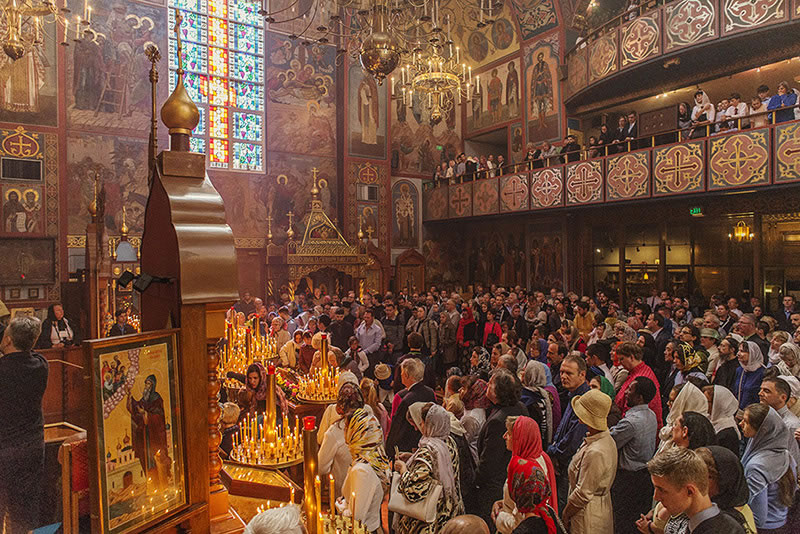
by Fr. Jonathan H. Cholcher
The Apostle describes the Church as a Body, and Christians as members of that body. “For as the body is one and has many members, but all the members of that one body, being many, are one body, so also is Christ. For by one Spirit we were all baptized into one body – whether Jews or Greeks, whether slaves or free – and have all been made to drink into one Spirit. For in fact the body is not one member but many…Now you are the body of Christ, and members individually” (1 Cor. 12:12-14, 27).
In its most basic sense, Church Membership means being a member of the Body of Christ, the Church, and Church Membership is accomplished through Holy Baptism into Christ. In other words, Church Membership is the status of the baptized children of God who participate in the Body of Christ otherwise known as the Church.
Elsewhere the Apostle writes of the dynamic nature of Church Membership: “[that we] may grow up in all things into Him who is the head – Christ – from whom the whole body, joined and knit together by what every joint supplies, according to the effective working by which every part does its share, causes growth of the body for the edifying of itself in love” (Eph. 4:15-16). One is a member of the Church insofar as one remains connected to and grows with the rest of the Body.
Being the Body of Christ, the Church is a tangible, living thing. The Church can be seen, heard, touched, and handled (see 1 John 1:1-4). Therefore Christians, being members of the Body of Christ, are just as tangible, living, and active. Certain key activities indicate genuine Church Membership.
The first, already mentioned, is baptism into Christ. Members of the Church are baptized in water in the name of the Father and of the Son and of the Holy Spirit, who are also sealed with the gift of the Holy Spirit, a physical act of anointing with Holy Chrism (anointing oil; see 2 Cor. 1:21-22; 1 John 2:20, 27). The Orthodox name for this anointing is Chrismation. Then, members of the Church gather for and receive Holy Communion, the Lord’s Supper, frequently and often. As a matter of fact, the gathering of the baptized/chrismated for Holy Communion is the very definition of the Church itself (Acts 2:38-42; 1 Cor. 11:17-26). The Greek word ekklēsia usually translated with the English “church” literally refers to an “assembly” gathered for the express purpose of receiving Holy Communion, the very Body and Blood of Christ.
Apart from Baptism and Holy Communion there is no such thing as “church,” and there is no such thing as “church membership,” no matter what you call it. Members of the Church are baptized, and they gather regularly and often to receive Holy Communion. So another indicator of Church Membership is active engagement in one’s local Church where the faithful actually gather for the Divine Liturgy and mutual fellowship. Wherever Christians reside, they should seek out and resolve themselves to participate in the life of the local Church where the Divine Liturgy is served and the members of the Body of Christ care for one another (see Rom. 16:1, 5, 16; Col. 4:16; etc.).
In this way, Church Membership manifests a true faith “which was once for all delivered to the saints” (Jude 3). The Christian Faith into which one is born in Baptism is living and active, always “working through love” (Gal. 3:26-27; 5:6). “What does it profit, my brethren, if someone says he has faith but does not have works? Can faith save him?…For as the body without the spirit is dead, so faith without works is dead also” (Jam. 2:14, 26).
Genuine Church Membership can never be defined as a status of dead letters, for instance, simply being listed on the Church roles as historically baptized, or having paid the required Church monetary dues, or having satisfied the yearly requirement of Confession and Communion at Pascha, etc. Genuine Church Membership reveals itself in the ongoing, deliberate, and loving participation in the life of Christ and His Body. Members of the Church who truly believe in Christ are alive in the Spirit to strive for repentance and forgiveness, practice righteousness, and care for their neighbor beginning with the household of God (Gal. 6:9-10; 1 Tim. 3:15). Therefore Church Membership entails a living relationship with God and the other members of the Church actively involved in the Eucharistic assembly of the Divine Liturgy.
Once properly understood as a living relationship with a living Body, all the duties of Church Membership can be understood not merely as “obligations” to remain “in good standing.” Rather, the duties of Church Membership are natural behaviors necessary for the care and growth of the Church.
Going to Confession is not just repairing one’s private relationship with God; instead, Confession is reconciliation with God and the rest of the Church, especially as the penitent seeks to receive Holy Communion together with the entire Body of the Church (Matt. 5:23-24; 16:19; 18:15-20). Attending the services of the Church is not just a self-help program for personal spiritual growth; instead, attending the services is “teaching and admonishing one another in psalms, hymns, and spiritual songs” so that “the word of Christ dwells in you richly in all wisdom” (Col. 3:16). Contributing tithes, freewill offerings, and the treasure of one’s time and talent is not just providing for the “business” of the Church on behalf of its patrons; instead, offerings are the sacrifice of one’s body and soul in thanksgiving to the grace of God in Christ who gave Himself for us all (2 Cor. 8:9; 9:10-15).
Church Membership as it has been variously defined brings certain privileges. Why else would someone “join” the Church, except to receive certain privileges, or benefits. Unfortunately, even among Christians, these privileges easily devolve into this-worldly benefits: an appearance of professional integrity, altruism, the ability to vote on Church business and serve on Church committees, a guarantee of funeral rites, among others. Thus Church Membership can often be seen as a means to a greater end, that is, an end other than that of the Body of Christ which is the kingdom of God and eternal life.
The ultimate privilege of Church Membership is “Christ in you, the hope of glory” (Col. 1:27). There is no greater benefit than the forgiveness and indestructible Life given and received by the faithful baptized at each and every Divine Liturgy (see Heb. 8:1-6; 10:19-26; 12:22-24).
“For many walk, of whom I have told you often, and now tell you even weeping, that they are the enemies of the cross of Christ; whose end is destruction, whose god is their belly, and whose glory is their shame – who set their mind on earthly things. For our citizenship is in heaven, from which we also eagerly wait for the Savior, the Lord Jesus Christ” (Phil. 3:18-20). Members of the Church “set your minds on things above, not on things on the earth. For you died (in baptism), and your life is hidden with Christ in God” (Col. 3:2-3). Therefore at every Divine Liturgy before Holy Communion, the Church says: “Lift up your hearts. We lift them up unto the Lord.”
Church Membership is the Life of Christ; it is Life in Christ. The members of the Church must always strive for this goal and to grow more and more into Christ the Head. In growing closer to Christ, the members of the Church grow closer to each other, each member according to personal function moving toward the same goal of salvation in true communion with God the Holy Trinity and all the saints.