by Fr. Jonathan H. Cholcher
Newcomers to the Orthodox Church are familiar with ethnic and national qualifiers: Greek Orthodox, Russian Orthodox, Coptic (Egyptian) Orthodox, etc. These qualifiers historically originate from peoples seeking to retain a Christian identity within a cultural context threatened by foreign invaders and occupiers contrary to their Christian past. For instance, Greek Orthodoxy materialized especially after Greek independence from almost 400 years of Turkish Muslim rule.
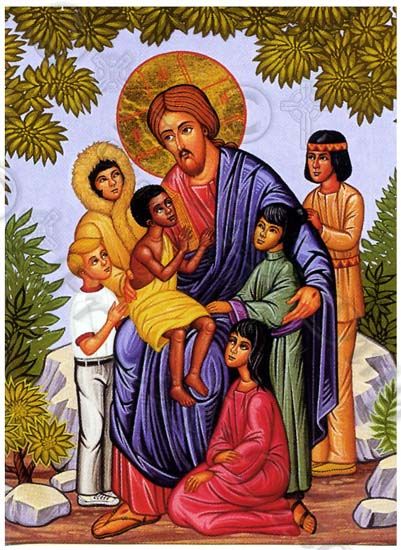
Ethnic and national qualifiers of Christianity have posed a persistent challenge to the identity of the Orthodox Church from ancient times. The apostles wrestled with identification based on Jewish or Gentile heritage (Acts 15). Saint Paul writes that Christians are “neither Greek nor Jew, circumcised nor uncircumcised, barbarian, Scythian, slave nor free, but Christ is all and in all” (Col. 3:11). Our Lord told Photini at the well: “Salvation is of the Jews” (Jn. 4:22); however, He also declared at the conclusion of the Gospel: “Go therefore and make disciples of all the nations…” (Matt. 28:19). Afterward Saint Peter was shown the vision of the great sheet containing all kinds of clean and unclean animals. He discerned from this that “in every nation whoever fears [God] and works righteousness is accepted by Him” (Acts 10:35).
One of the hallmarks of the Orthodox Church is its ability to establish basic Christianity in whatever cultural context it encounters. This is true of its Head, the Lord Jesus Christ, and this is true of His Body, the Church. “My kingdom is not of this world,” Jesus told Pilate (Jn. 19:36). The presence of the genuine, authentic Christian Church in whatever time and place it is found defines the nature of the Church as catholic, literally, “whole, or entire” (Gk., katholikē) apart from the diverse competing influences of the world.
The wholeness or entirety of the Orthodox Church does not depend on any specific ethnic or national characteristics. Early in the second century, a disciple wrote: “For the Christians are distinguished from other men neither by country, nor language, nor the customs which they observe…But, inhabiting Greek as well as barbarian cities, according as the lot of each of them has determined, and following the customs of the natives in respect to clothing, food, and the rest of their ordinary conduct, they display to us their wonderful and confessedly striking method of life…Every foreign land is to them as their native country, and every land of their birth as a land of strangers” (Epistle to Diognetus, chap. 5).
Orthodox Christians operate within certain systems of geo-political constraints (e.g., city, countryside, democratic or monarchical rule), clothing, hairstyles, cuisine, mannerisms, and etiquette, but none of these factors ultimately define what it means to be an Orthodox Christian, or to be more Orthodox. Some of these factors must be adopted or rejected depending on their association with true or false piety (see 1 Cor. 8:9-13; 10:31-33; 11:13-16), but it is the unadulterated truth of Christ that is always confessed by the Christian in word and deed. Orthodox means “right glory,” that is, giving glory to God alone without glorifying anything or anyone else as equal or greater value than God.
Worship of God the Holy Trinity is the one cultural, ethnic, and national constant of the Orthodox Church “always, everywhere, by everyone” (St. Vincent of Lerins; Lat., semper, ubique, ab omnibus). The Orthodox Church completes and transcends every other cultural construct because the Orthodox Church alone manifests the incorruptible and indestructible life of God given to human beings, which is our original purpose and reason for existence.
We do not exist simply to dress in certain kinds of costumes, or to eat certain kinds of foods and drink certain kinds of drinks, or to manipulate possessions, family, and neighbors according to historical ways of life passed on merely with respect to tribal or biological descent. When these concerns become paramount for Christians and the Church, then the worship of God gives way to idolatry, the service of something other than God no matter how well intentioned or traditional.
Ethnic and national concerns are exposed in greater relief in the organization of the American Orthodox Church. On the one hand, the governance of local American Orthodox churches tends to fall within jurisdictional lines: Greek, Russian, Antiochian (Syro-Lebanese), Serbian, Romanian, Bulgarian, etc. These jurisdictions are marked by a significant cultural identity notably including languages other than English and various customs from the “old” country. To this day, many persons in Orthodox parishes of ethnic jurisdictional identity are recent immigrants to America.
On the other hand, despite jurisdictional allegiance, local American Orthodox churches also include many persons seeking the Orthodox Faith who are not from the cultural background of the ethnic jurisdiction’s origin. Local American Orthodox churches eventually insist that converts assimilate to a certain cultural construct, or they succumb to the pressure to allow languages and customs not originally their own, sometimes minimizing or abandoning the ethnic origin altogether.
In America, trying to accommodate all these different “cultures” results in a patchwork quilt even more distracting from the Church’s primary purpose. Such a method departs notably from the Church’s mission strategy employed throughout most of its own history, first exemplified post-Pentecost in the Book of Acts. For instance, in the 9th century the Greek Saints Cyril and Methodius immediately learned the manners and language of the Slavs evangelizing them in their own language, literally inventing the written form of the Slavic language and translating the Scriptures and Orthodox services for their own use. They did this despite the Latins’ insistence to the contrary. Likewise Saint Innocent did the same among the Yupik and Athabascan peoples of Alaska in the 19th century.
The American Orthodox Church is uniquely positioned to be catholic in the truest sense of the word, namely, wholly and entirely devoted to God in Jesus Christ as defined by the Gospel of salvation. All the other ethnic, national, and cultural imperatives should be sacrificed to achieve “the one thing needed…’to turn from darkness to light, and from the power of Satan to God, that [all] may receive the forgiveness of sins and an inheritance among those who are sanctified by faith in [Jesus]’” (Lk. 10:42; Acts 26:18). The other extraneous competing interests should be filtered out to hear the clear message of communion with God and one another in the Kingdom of God’s love.
The American Orthodox Church calls for a genuine return to God. This is repentance in action, which means renouncing cultural priorities for the sake of knowing Jesus Christ alone. Ethnic or cultural concerns as the first priority in an Orthodox Church are stumbling blocks to the Faith, therefore a sin to be rejected because it alienates from the Church people not of those particular ethnic or cultural groups.
Conversely, the American Orthodox Church must remain focused on preaching and teaching the life of Christ which alone is the eternal salvation for all who hear it and see it in action. In this the American Orthodox Church must be hospitable to everyone for the sake of Christ. Hospitality for the sake of Christ is the proper way of beginning to offer various cultural elements to people under the banner of Orthodoxy, e.g., various foods, non-English words and phrases, feast-day practices. Cultural elements provide a sense of comfort to those who know them, and they are often new and wonderful expressions of joy to those unfamiliar with them.
God has given the Orthodox Church a renewed mandate in America. It is “the old commandment,” but it is always a “new commandment” (see 1 Jn. 2:7-8) because it must ever be enacted anew in each generation and in every place the Gospel reaches. “Make disciples of all the nations…” (Matt. 28:19). Be the Church wherever you are, in every locality: the Body of Christ, the Temple of the Holy Spirit, the Family of God the Father (see Eph. 1-3). “Now may the God of peace who brought up our Lord Jesus from the dead, that great Sheperd of the sheep, through the blood of the everlasting covenant, make you complete in every good work to do His will, working in you what is well pleasing in His sight, through Jesus Christ, to whom be glory forever and ever. Amen” (Heb. 13:20-21).