by Fr. Jonathan H. Cholcher
John the Baptist declared, “I indeed baptize you with water unto repentance, but He who is coming after me is mightier than I, whose sandals I am not worthy to carry. He will baptize you with the Holy Spirit and fire.” (Matthew 3:11; cf. Mark 1:7-8; Luke 3:16; italics mine)
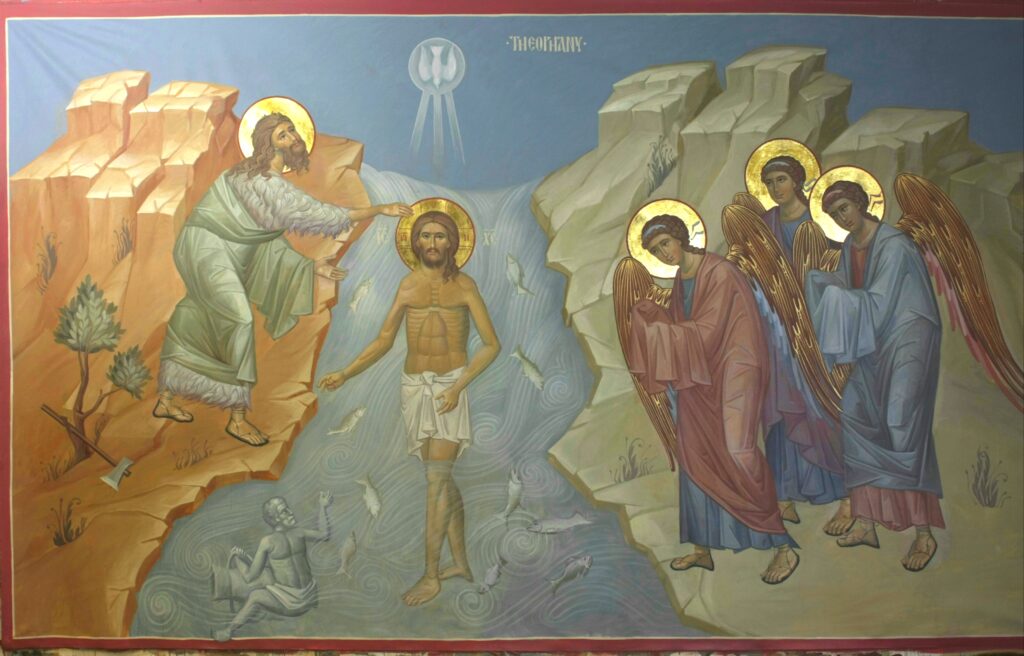
When Jesus was baptized by John in the Jordan River, He told John that in doing this “it is fitting for us to fulfill all righteousness” (Matthew 3:15). Coming up from the water, the Holy Spirit descended from heaven in the form of a dove and alighted on Christ, and the Father spoke from heaven, saying, “this is My beloved Son, in whom I am well pleased” (Matthew 3:16-17; cf. Mark 1:10-11; Luke 3:21-22).
John would then testify: “’This is He of whom I said, “After me comes a Man who is preferred before me, for He was before me.” I did not know Him; but that He should be revealed to Israel, therefore I came baptizing with water.’ And John bore witness, saying, ‘I saw the Spirit descending from heaven like a dove, and He remained upon Him. I did not know Him, but He who sent me to baptize with water said to me, “Upon whom you see the Spirit descending, and remaining on Him, this is He who baptizes with the Holy Spirit.” And I have seen and testified that this is the Son of God.’” (John 1:30-34; italics mine)
We also read in the Gospel that after His baptism in the Jordan, Jesus Himself baptized people in water, that is, through the agency of His disciples (John 3:22, 26; 4:1-2). As Jesus explained to Nicodemus, “Unless one is born of water and the Spirit, he cannot enter the kingdom of God. That which is born of the flesh is flesh, and that which is born of the Spirit in spirit” (John 3:5-6). John answered the dispute of who’s baptism is superior, “’I have been sent before [the Christ]…He must increase, but I must decrease…For He whom God has sent speaks the words of God, for God does not give the Spirit by measure. The Father loves the Son, and has given all things into His hand” (John 3:28, 30, 34-35).
From Christ’s own baptism in the Jordan and His own disciples’ subsequent baptizing with water, it is clear that baptism with water and baptism with the Holy Spirit are one and the same thing. Water and the Spirit are joined in the Son sent from the Father, and this Baptism of Christ is the means of new birth given to persons otherwise dying in the sinful flesh and thereby excluded from the spiritual dominion (kingdom) of God.
The addition of the Spirit to baptism with water completes the act as a revelation of God the Holy Trinity. Again, as John testified, “I did not know Him (God the Son/Christ), but He who sent me (i.e., God the Father) to baptize with water said to me, ‘Upon whom you see the Spirit (of God) descending, and remaining on Him, this is He who baptizes with the Holy Spirit’” (John 1:33). Thus the Lord commands His apostles to “make disciples of all the nations, baptizing them in the name of the Father and of the Son and of the Holy Spirit” (Matthew 28:19).
The apostles clearly understood this command on the Day of Pentecost in which they were “filled with the Holy Spirit and began to speak with other tongues, as the Spirit gave them utterance” (Acts 2:4). They were filled with the Holy Spirit who revealed Himself as a “rushing mighty wind” and “tongues, as of fire,” sitting upon each of them (Acts 2:1-3). After preaching the Gospel to the crowd calling the people to repentance for murdering Christ crucified and risen, the apostle Peter said, “’Repent, and let every one of you be baptized in the name of Jesus Christ for the remission of sins; and you shall receive the gift of the Holy Spirit’…those who gladly received his word were baptized” (Acts 2:38, 41; italics mine).
Baptism in the name of Jesus Christ is simultaneously the baptism in God the Father, and the baptism in the Holy Spirit. Likewise, the baptism of the Holy Spirit is simultaneously the baptism of God the Father, and the baptism of Jesus Christ. Where one Person of God the Holy Trinity is working, all three Persons of the Godhead are working. Christian Baptism always includes all three Persons of the Godhead, the Father and the Son and the Holy Spirit, and the mention of one Person implies the presence and activity of the other two Persons.
“But you were washed, but you were sanctified, but you were justified in the name of the Lord Jesus and by the Spirit of our God (i.e., the Father)” (1 Corinthians 6:11). “There are diversities of gifts, but the same Spirit. There are differences of ministries, but the same Lord (i.e., the Son, Jesus). And there are diversities of activities, but it is the same God (i.e., the Father) who works all in all…For by one Spirit we were all baptized into one body (i.e., Christ)” (1 Corinthians 12:4-6, 13). “For you are all sons of God (the Father) through faith in Christ Jesus (the Son). For as many of you as were baptized into Christ have put on Christ…And because you are sons, God (the Father) has sent forth the Spirit of His Son into your hearts, crying out, ‘Abba, Father!’” (Galatians 3:26-27; 4:6). [N.B. The Aramaic term Abba means Daddy; cf. Romans 8:14-17.]
Again, “When the kindness and the love of God our Savior toward man appeared, not by works of righteousness which we have done, but according to His mercy He saved us, through the washing of regeneration and renewing of the Holy Spirit, whom He poured out on us abundantly through Jesus Christ our Savior, that having been justified by His grace we should become heirs according to the hope of eternal life” (Titus 3:4-7). This statement of the apostle is typical baptismal language referring to the joining of water and the Spirit in the context of the working of God the Holy Trinity.
Returning to the words of St. John the Baptist and the events of the Day of Pentecost, the Baptism of the Holy Spirit into Christ is revealed by two attending “signs”: fire and speaking in tongues. “[Christ] will baptize you with the Holy Spirit and fire” (Matthew 3:11). “There appeared to [the disciples] divided tongues, as of fire, and one sat upon each of them. And they were all filled with the Holy Spirit and began to speak with other tongues, as the Spirit gave them utterance” (Acts 2:3-4).
Fire is a sign of the Holy Spirit’s presence burning, hence, purifying from sin and refining the faithful in the light of Christ. The Angel of the Lord (the Son and Word of God; see Genesis 16:7; Isaiah 9:5) appeared to Moses in a flame of fire from the midst of a bush. The bush was burning with fire, but the bush was not consumed (Exodus 3:2). The seven-branched lampstand standing in the Holy Place of the Tabernacle and Temple was never to go out, but continually burn and give light (Exodus 27:20-21; Zechariah 4:2-6). The pillar of cloud by day and fire by night led the Israelites through the wilderness to the Promised Land (Numbers 9:15-18; Isaiah 63:11-14).
Specifically Isaiah writes: “[T]he Lord shall wash away the filth of the sons and the daughters of Zion, and shall purge the blood of Jerusalem from their midst by the Spirit of judgment and the Spirit of burning. He shall come and there shall be with regard to Mount Zion and everything round about, a cloud to overshadow it by day, and as it were smoke and light of fire burning at night, and it shall be covered altogether with glory” (4:4-5).
The fire of the Holy Spirit is uncreated, that is, not a physical or material flame subject to natural law. The fire of the Holy Spirit is His operation purifying from the spiritual dross of sin and illumining the path of the cleansed to pursue righteousness in the way of Christ. This refining operation of the Holy Spirit is joined to the washing with water in Holy Baptism as the ongoing activity of the Holy Spirit in the lives of the faithful.
Speaking in tongues is a sign of the Holy Spirit’s presence enabling people to hear and understand the Word of God “in their own language” (Acts 2:8), so that people come to repentance, faith, and the knowledge of God their Savior. The Spirit’s gift of tongues is the ability to speak in other, or foreign, languages, and to communicate or translate the Gospel of Christ to persons in those languages. Thus the Apostle Paul writes that interpretation must accompany speaking in the Church in a tongue (foreign language); otherwise, lacking interpretation (translation) the one who wants to speak in a tongue should keep silent (1 Corinthains 14:9-19, 27-28).
After quoting the prophet (Isaiah 28:11, 12), the Apostle calls speaking in tongues a “sign, not for those who believe but to unbelievers” (1 Corinthains 14:22). This was precisely the purpose of speaking in tongues on the Day of Pentecost and thereafter in the missionary preaching of the Gospel of Christ. “But you shall receive power when the Holy Spirit has come upon you; and you shall be witnesses to Me in Jerusalem, and in all Judea and Samaria, and to the end of the earth” (Acts 1:8). Speaking in tongues, along with other signs (Mark 16:17), is an indication confirming the working of the Holy Spirit who calls all to the same faith and baptism into Jesus Christ regardless of race or region.
The experience of the Day of Pentecost, the tangible gift of the Holy Spirit “falling upon” believers, was repeated at critical steps in the spread of the Gospel: in Samaria (Acts 8:14-18); in Gentile Caesarea (Acts 10:44-48); in Ephesus (Acts 19:1-7). The apostle Peter explained: “And as I began to speak, the Holy Spirit fell upon [the Gentiles], as upon us at the beginning. Then I remembered the word of the Lord, how He said, ‘John indeed baptized with water, but you shall be baptized with the Holy Spirit.’ If therefore God gave them the same gift as He gave us when we believed on the Lord Jesus Christ, who was I that I could withstand God?” (Acts 11:15-17; italics mine). Concerning this manifestation of the Holy Spirit to Gentile believers, Peter at that very time expressed the necessary link with Christian baptism. “’Can anyone forbid water, that these should not be baptized who have received the Holy Spirit just as we have?’ And he commanded them to be baptized in the name of the Lord” (Acts 10:47-48).
Speaking with tongues, along with other signs such as casting out demons, healing the sick, and remaining unharmed from serpents and poison, are gifts given by the Holy Spirit when needed to arouse unbelievers to faith in Christ. To this day the Orthodox Church continues to witness these signs performed in its midst. However, these signs cannot be expected every time a person comes to faith in Christ and is baptized into Christ. The fact that every person baptized into Christ does not speak in tongues does not nullify the fact that Christian Baptism in water is also the Baptism of the Holy Spirit. Greater gifts than speaking in tongues are given in Baptism providing even greater evidence of the presence of the Holy Spirit in the lives of the faithful, e.g., endurance under suffering (Romans 8:17), prophesying (calling to genuine repentance; 1 Corinthians 14:1, 24-25), and the fruits of the Spirit (Galatians 5:22-25).
In the Orthodox Church water Baptism is always conjoined to anointing with the Holy Chrism, or the seal of the Holy Spirit, according to the apostolic pattern evident in the Book of Acts (8:17; 19:6). “Now He who establishes us with you in Christ and has anointed us is God, who also has sealed us and given us the Spirit in our hearts as a guarantee” (2 Corinthians 1:21-22). “[Y]ou were sealed with the Holy Spirit of promise, who is the guarantee of our inheritance” (Ephesians 1:13-14). “But you have an anointing (Gk., chrisma) from the Holy One, and you know all things…But the anointing which you have received from Him abides in you” (1 John 2:20, 27).
Thus Chrismation – anointing with Holy Chrism – completes Baptism as a manifestation of the new life in communion with God the Holy Trinity. The Baptism of the Holy Spirit actively establishes and protects the Christian (lit., anointed one) in faith, hope, and love in Christ (lit., the Anointed One).